
Women at the Table

A fair future
starts here

We don’t just analyze digital infrastructure and feminist AI—we build it. For a decade, Women at the Table has sparked systems change by redesigning the tables where decisions shape our world, not just adding seats.


Our mission: forge technology that strengthens democracy, advances gender equality, and protects human rights.


For a decade, Women at the Table has sparked systems change by redesigning the tables where decisions shape our world, not just adding seats.

Our Work

Some of our groundbreaking work

W@tt’s Up

News

Apertus: The Open AI Model That Can Prove Its Bias

Switzerland’s open model Apertus is the only frontier AI whose training data can be audited for the gender gap that makes AI misdiagnose women.
News

The Architecture Is Being Built Right Now.

Here is Where to Find the Doors

News

AI Cannot Outperform the Evidence It Was Built On

New Paper: How Biased Data Is Shaping Who Lives, Who Is Believed, and Who Is Left Behind

News

When Algorithms Discriminate: Tech Bias in Justice Systems

The Algorithm Took Notes: What We Learned at CSW70 About Tech Bias in Justice Systems

News

AI & Equality Annual Report

The future of AI isn’t predetermined. We have the agency to shape it. This 2024-2025 report shows what that looks like in practice.

News

Invisible by Design: Women’s Health as the Blind Spot in AI

A landmark collaboration between Women at the Table and FemTechnology, our latest paper isn’t just a report; it’s a call for a new “Social Contract for Data.”

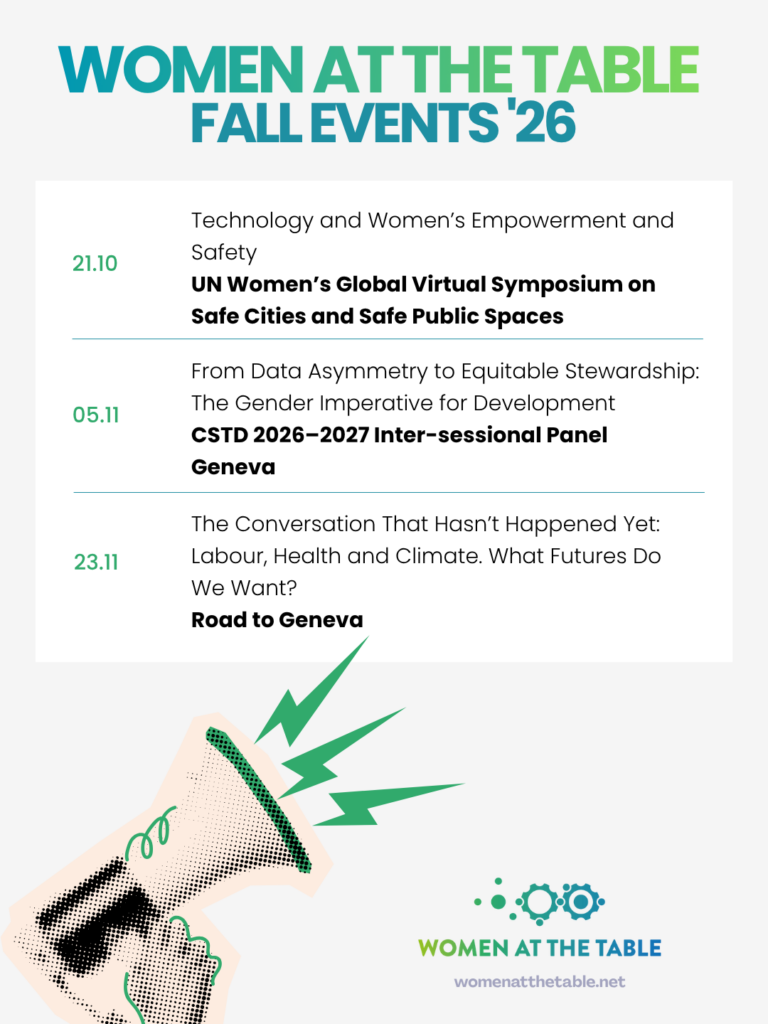
Upcoming events & talks

Women at the Table in Geneva AI Events ’26 

This summer, Geneva hosts the inaugural Global Dialogue on AI Governance, the WSIS+20 High-Level Event, and AI for Good — all in the same week.


The frameworks, standards, and institutions that will shape digital transformation for the next decade are being renegotiated right now.


Women at the Table is convening six events across the Human Rights Council, WSIS+20, and AI for Good to ensure gender equality and human rights are embedded in that architecture — not added as an afterthought.

Digital International Geneva thematic session on HumRights-Bench

Jun 308:30 am - 9:30 am

Digital International Geneva thematic session on HumRights-Bench

Campus Biotech, Chemin des Mines 9, 1202 Geneva

Feminist AI Innovation from the Global South: From Community to Global Governance Commitments

Jul 052:00 pm - 5:00 pm

Feminist AI Innovation from the Global South: From Community to Global Governance Commitments

Inclusive AI Research Network (formerly the Feminist AI Research Network FAIR) and the Gender in Digital Coalition, are a global feminist coalition that works to promote and ensure intersectionality and gender mainstreaming in global digital governance frameworks.

WSIS Forum 2026 | Public Trust and AI Procurement: From Principles to Practice

Jul 069:00 am - 9:45 am

WSIS Forum 2026 | Public Trust and AI Procurement: From Principles to Practice

Drawing on new research, this session introduces a public trust framework for AI procurement and maps concrete mechanisms — auditability, documentation, risk assessment — to embed human rights and transparency upstream, before systems are deployed.

WSIS Forum 2026 | Measuring What Matters: Embedding Gender Equality in AI Governance Through Gender-Specific Indicators

Jul 062:00 pm - 2:45 pm

WSIS Forum 2026 | Measuring What Matters: Embedding Gender Equality in AI Governance Through Gender-Specific Indicators

This session surfaces what current indicators miss and maps concrete governance entry points to embed gender-specific, actionable indicators — before standards are locked in.

WSIS Forum 2026 | Fit for Whom? Sex-Stratified Data and the Integrity of High-Risk AI

Jul 0710:00 am - 10:45 am

WSIS Forum 2026 | Fit for Whom? Sex-Stratified Data and the Integrity of High-Risk AI

Drawing on three recent research papers, this session presents evidence of the cascade from male-default data to biased outputs across healthcare, criminal justice, and social care, then maps what needs to change in data standards, validation requirements, and governance frameworks.